


Insights Blog
Quarterly Market Commentary
October 13th, 2026 // Jack LaLiberte
Market Recap
Equity markets displayed continued resilience in the third quarter, with remarkably low levels of volatility. This is notable due to the wild fluctuations in interest rates and inflation expectations over the past six months. Both interest rates and inflation remain elevated relative to their pre-Iran conflict levels and structural factors suggest that higher rates are likely to persist. Although the inflation outlook remains a concern, growth fundamentals are relatively sound. Domestically, employment and consumer health remain stable. Shifting macroeconomic narratives and concerns around AI over-investment have led to broader divergence in equity performance in recent quarters, demonstrating the prudence of a diversified equity allocation.
Looking Ahead
Regardless of the outcome of the Middle East conflict, inflation appears to be persistent. AI investment has driven up the cost of electronic components and electricity, while energy prices continue to pressure goods and wages, as higher fuel prices wind through the supply chain. In the near term, risks appear tilted towards a slower pace of growth rather than an elevated likelihood of a recession. Dwindling consumer savings, elevated government debt levels, questionable returns on AI investments and a lack of labor force expansion are likely to hamper domestic economic growth. Those headwinds have been offset by tremendous levels of global earnings growth. As we’ve seen in recent years, the best defense against volatility is a broadly diversified portfolio. Many of the largest US equities have underperformed the broader indices thus far in 2026, given lofty earnings growth expectations and reliance on continued AI exuberance to justify valuations. International equity valuations are far more palatable, while also providing exposure to a more diverse array of potential growth catalysts. Fixed income yields have become more attractive in recent months, particularly relative to cash, rewarding investors willing to accept modest duration risk.
Asset Allocation
Equity markets in 2026 have been relatively placid since the Spring, as impressive earnings growth has been offset by a rapid increase in the discount rate. The dispersion in performance over the past few years serves as a case study in the prudence of diversification. The global growth outlook appears more tepid but remains far from recessionary levels. As such, we prefer to remain exposed to the largest number of potential growth catalysts, rather than concentrating exposure around a singular trend. Please don’t hesitate to reach out to your advisor to schedule time to discuss your financial plan, including your goals and planning assumptions. Allowing planning to drive portfolio construction, rather than prognostication, helps ensure that your portfolio remains aligned with your vision for the future.
Leading Topics
Economic Fundamentals
The US labor market remains in a tentative equilibrium, with low levels of layoffs and an uptick in hiring. Labor force participation for individuals aged 25-54 sits near a record high, indicating that although headline job creation numbers may be underwhelming, AI-related labor demand concerns are likely overblown, at least in the near term. Aggregate consumer spending is holding up, although it is increasingly driven by a narrow subset of households. Consumer debt service ratios and delinquencies have stabilized, although elevated energy prices are likely to continue to pressure lower income households. Domestic GDP growth has become increasingly dependent on a small segment of consumers as well as a torrid pace of corporate investment. The global outlook is more compelling, with the IMF estimating 3%+ GDP growth globally in 2026.
The Federal Reserve, Inflation & Fixed Income
The return of inflationary pressure has engendered considerable interest rate volatility in recent months. Markets now expect the Fed to raise rates another 1-2 times in 2026, a sharp contrast to the cuts forecast at the beginning of the year. The increase in longer-term rates likely reflects the market’s lack of faith in the Federal Government’s ability to control deficits, as well as a lack of appetite to meaningfully address inflation. While fixed income returns have been tempered by rate volatility, higher yields provide investors with a buffer against interest rate swings. Given elevated equity valuations and a softer growth outlook, the opportunity set in fixed income is compelling. We believe that a moderate approach to both duration and credit quality is appropriate, as the yield curve is likely to steepen and spreads remain modest. Investors with outsized cash holdings should consider duration extension to lock in attractive yields.
Global Equity Markets
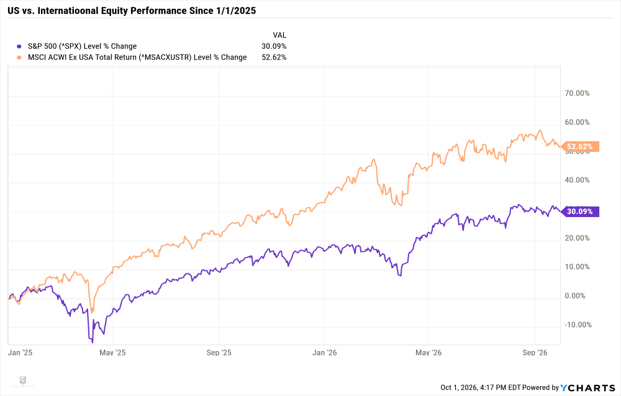
The past few years have rewarded equity diversification after a lengthy period of narrow leadership, with small-caps and international equities outperforming their large cap domestic counterparts. Valuations have moderated this year, largely due to a dramatic pace of earnings expansion. Domestically, concentration remains a concern, with 10 companies making up nearly 40% of the S&P 500 market cap. Many of the largest US companies have invested heavily in the ongoing artificial intelligence buildout. Should lofty return expectations for these investments fail to materialize, concentrated exposure leaves investors vulnerable to outsized volatility. Outside the US, investors can unlock exposure to a far broader set of potential tailwinds. These unsung but powerful growth opportunities include the European defense sector, developed market banks and Taiwanese technology firms, all of which have quietly outperformed US growth equities over the past four years. Diverse equity exposure allows portfolios to better weather uncertainty and opens multiple avenues for growth.
US Economic Outlook: Tepid Resilience
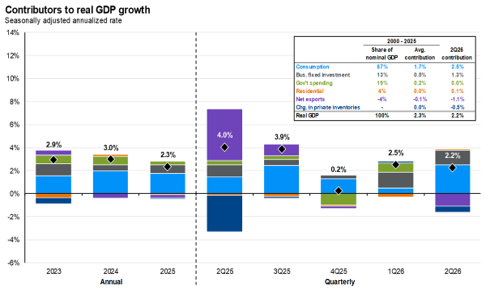
Over the past several years, the global economy has demonstrated remarkable resilience in the face of trade disruptions, geopolitical conflict and shifting monetary policy regimes. US GDP has entered a period of slower but still positive growth. Risk remains tilted towards a gradual slowdown in growth, driven by higher cost of capital, inflationary uncertainty as well as a shrinking workforce. Corporate investment and consumer spending remain the largest drivers of GDP growth.
In the second quarter, consumer spending accounted for 68% of GDP growth. While the consumer remains resilient, supported by a stable labor market, some indicators have raised concern, particularly at the lower end of the income spectrum. Wage growth has slowed to 3%, below the level of inflation. The recent volatility in energy prices has been particularly impactful for lower income consumers. The bottom quintile of consumers, by income level, spend 17% of their income on energy, while the top 20% of consumers spend less than 3% of their income on energy. Auto loan and credit card delinquencies are also near 20-year highs, signaling strain for lower income consumers. However, overall consumer debt remains well below the levels that preceded the 2008 Financial Crisis. The consumer outlook points to continued stability but there is likely little room for substantial growth, barring a rapid easing of inflationary pressure or a reversal of the decay in wage growth.
The labor market remains supportive of consumer spending. While wage growth and job creation have been unspectacular, a shrinking labor force should continue to provide favorable supply-side tailwinds for labor. The supply crunch is driven by two primary factors: a lack of immigration flows and an aging workforce. Immigration flows have collapsed over the past two years, from an estimated 2.7 million in 2024 to an estimated 300,000 this year. The domestic workforce is shrinking, with approximately 5 million Americans claiming Social Security annually, as compared to about 4 million turning 18 each year. JPMorgan estimates that the domestic workforce will likely shrink by about 0.3% annually over the next decade. This should provide some tailwinds for wages and support stable unemployment going forward, although a smaller labor force will likely hamper overall economic growth.
The second factor that has supported GDP growth in recent quarters is robust corporate investment. AI-related capital investment has grown rapidly, from about 1.5% of GDP in 2025 to an estimated 2-2.5% this year. In 2025, AI-related capital investment accounted for about 10% of total corporate investment. While artificial intelligence represents a compelling technology, the impact on productivity thus far has been debatable. What is clear is that the current investment cycle has provided a near-term boost to GDP growth. Whether that level of investment and growth is sustainable is yet to be seen.
US Equities: Concentration & Dispersion
While the first six months of the year were characterized by substantial equity market volatility, largely surrounding the impact of the conflict with Iran, domestic equities have been range-bound over the past quarter. Equity performance consists of two components: earnings and multiples. Earnings growth has been strong this year, with S&P 500 companies growing earnings at more than a 30% year-over-year clip. Multiple stagnation has had an offsetting impact, likely due to a rapid increase in the discount rate. These structurally higher rates are likely to cap multiples in the near term, as investors adjust their expectations around the long-term cost of capital. Another headwind to multiple expansion, which could shift more quickly, is the degree of overall policy uncertainty, including a lack of clarity around future energy prices and trade policy. That uncertainty is exacerbated by the looming midterm elections. However, these concerns are more readily addressable than the upward pressure on the yield curve. A reduction in the level of uncertainty, whether due to a deal on Iran or a decisive midterm outcome, could allow for some stabilization in equity multiples.
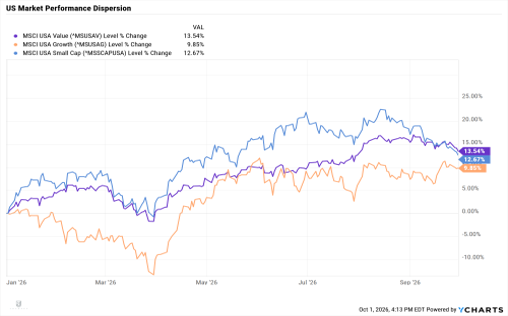
Despite wider dispersion in equity returns, the S&P 500 remains remarkably concentrated, with over 40% of the index weighting comprised of just 10 names. Nine of these 10 companies are in the technology space and offer only a modicum of diversification. While it’s difficult to argue that the ongoing development of artificial intelligence won’t prove to be transformational, the risk remains that the pace of investment may surpass the tangible impact on profitability. A lapse in AI-related optimism would likely impact the largest S&P 500 components disproportionately. The Index also offers little in terms of value, with a P/E ratio of 20x forward earnings, slightly above the long-term average and well above the typical level when the 10-year Treasury yield sits above 5%. We advocate for the unexciting but prudent practice of diversification, now more than ever. Diversification doesn’t necessarily mean accepting lower returns, it simply means broadening portfolio exposures to catch a wider variety of tailwinds, rather than solely relying on a single trend. Small cap US equities and international markets offer exposure to a broader array of opportunities, without the degree of concentration or the lofty valuations on offer in the narrow neighborhood of US large cap growth equities.
Global Equity Opportunities
Equity performance represents the convergence of fundamentals and expectations. Domestically, earnings are growing at a pace not seen since the COVID recovery. However, US large caps have underperformed relative to small-cap and international segments. Elevated valuations leave little room for disappointment. International equities represent the opposite side of the coin. Multiples are low enough that it takes little improvement in expectations to generate compelling performance. In 2026, international earnings, particularly those in emerging markets, have grown dramatically. Emerging market earnings growth is expected to be nearly 50% this year. While AI is a part of the story, international equities are exposed to a broader variety of tailwinds than their domestic counterparts. Although many investors have become conditioned that US equities always outperform, given their generational run over the past decade and a half, historically, equity leadership tends to shift frequently. That’s been evidenced by the international outperformance of the past few years.
While the AI revolution certainly seems to provide some tailwinds, and generates an outsized amount of attention, there are other segments of the global equity universe that present compelling opportunities. In Asia, a burgeoning middle class is driving economic development. China weathered US tariffs well, with exports hitting a record high in 2025. A shift towards manufacturing more complex goods has solidified China’s dominant position in global export markets. In Europe, energy-related risks remain. However, substantial investments in defense and infrastructure, as well as tariff reductions, will likely continue to support gradual growth. Two constants during the 15-year era of US equity market exceptionalism were a strong Dollar and historically low interest rates. As both of those dynamics have shifted, so has the global economic landscape and the relative attractiveness of various investment opportunities. While no one knows what the future holds, global diversification seems prudent given the elevated valuations and considerable level of concentration present in US equity markets.
Inflation & The Federal Reserve
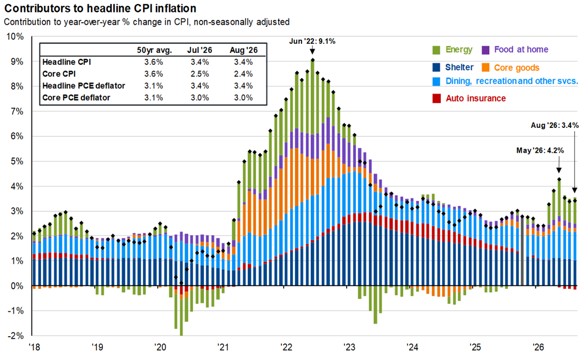
After peaking in May at just over 4%, inflation has cooled slightly to 3.4%. The obvious driver is energy prices, given the ongoing Middle East conflict. Core inflation, stripping out food & energy prices, is far closer to the Fed’s 2% target at 2.4%. Uncertainty around the path of inflation remains. While there are some encouraging trends, such as the continued disinflation in shelter costs, the second order effects of higher energy prices are likely to continue to reverberate through the economy. The more subtle inflation driver has been the AI buildout, which has pressured the cost of electricity, chips and other electronic components. The Producer Price Index for semiconductors and other electronic component manufacturing jumped by nearly 27% over the past year. On a positive note, tariff-related inflation continues to wane, as the uncertainty around trade policy has declined. Longer-term futures contracts indicate some modest downward pressure on oil prices by the end of the year. One-year inflation swaps point to a slightly cooler but still above-target inflation level of around 2.6%.
Given the continued persistence of inflation as well as the upward pressure on long-term yields, the Fed had little choice but to raise rates in September. Futures markets are pricing in another 1-2 rate hikes this year. Given accommodative fiscal policy, a stable labor market and the Fed’s continued quantitative easing, the FOMC likely has some leeway to raise rates without substantially encumbering economic growth. The shift in inflationary and Fed expectations has been dramatic this year. As recently as February, the market anticipated about 2-3 cuts, which has now been replaced with an expectation of 2-3 hikes, a dramatic swing over the course of 7 months. The shift in expectations around inflation and Fed action has translated to the longer end of the yield curve as well, with the 10-year Treasury yield surpassing 5%, the highest level in nearly 20 years. Even with the Fed raising short-term rates, the gap between money market and core fixed income yields has widened, providing an incentive for investors to add duration. Rate hikes are likely to place additional pressure on low-income consumers, given elevated levels of consumer debt. Higher rates are also likely to constrict housing market activity, which has already been limited.
Fixed Income Outlook
While bond markets have experienced some volatility this year due to a shifting inflation outlook and the associated policy ramifications, the opportunities available within fixed income are difficult to ignore. Core bonds currently offer yields that are attractive on a relative and absolute basis, with investment grade bonds yielding about 5.5%. That represents a premium of more than 100 bps over money market rates. Although money market yields are likely to remain stable or increase slightly, we believe that the existing spread presents an attractive opportunity to modestly extend duration.
Although fixed income returns have been unspectacular in recent years, particularly when compared to torrid equity market performance, the asset class has demonstrated a remarkable level of resilience in the face of considerable rate volatility. Given the 100 bp increase in the yield on the 10-year Treasury, alongside hefty corporate issuance, the modest magnitude of the drawdown in fixed income is commendable. This illustrates the insurance that higher yields can provide. In 2022, yields didn’t provide any insulation against rate volatility. That has since changed, with fixed income offering more adequate compensation for taking duration risk.
The fixed income landscape is dynamic. Given the shifting yield curve and credit spreads, an active approach to the asset class is valuable. While a cap-weighted approach to equity investing makes some sense, that methodology seems inappropriate for devising a fixed income allocation. Allocating the largest weights to the issuers with the most debt seems like a suboptimal capital allocation strategy. The Bloomberg Aggregate Bond Index, for example, is made up of about 70% Treasury and mortgage-backed securities. The Index takes little credit risk, which on the surface seems appealing, but also sacrifices yield while exposing investors to substantial duration risk. We believe that skilled managers with wide mandates can take advantage of inefficiencies and dislocations in the fixed income markets to extract superior risk-adjusted returns relative to a passive index.
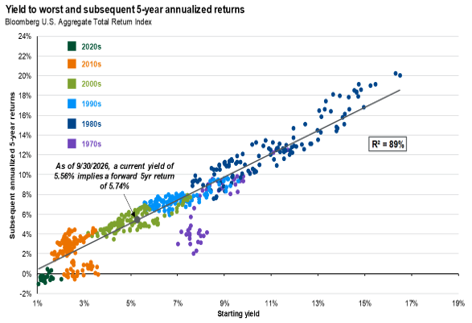
Although fixed income prices have proven volatile over the past few quarters, yields are attractive. The relationship between starting yields and subsequent returns has historically proven to be strong. Against the backdrop of stretched equity valuations and a slower growth outlook, fixed income yields appear compelling, especially for investors who are beginning to draw on their portfolios and are particularly sensitive to sequence-of-return risk.
Midterm Elections: Cutting Though the Noise
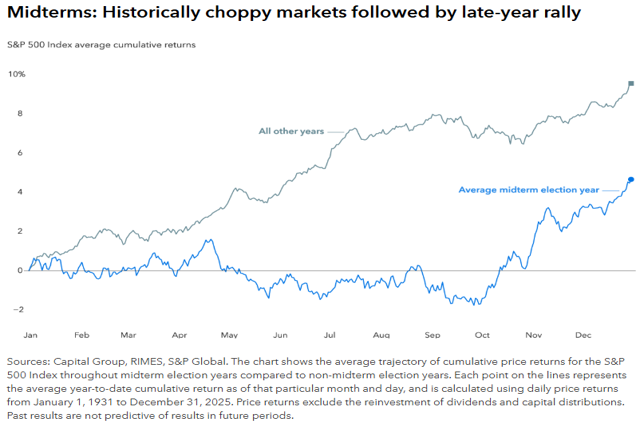
In both midterm and Presidential election years, equity markets tend to underperform prior to the election, relative to non-election years, likely due to the elevated level of uncertainty. As the election outcome and its implications become clearer, markets tend to rally. Historically, the party controlling the White House tends to lose seats in midterm elections, making a divided government a very real possibility. Historically, equity markets tend to perform better under divided governments than when either party has control of both the legislature and executive branches. The inability of either party to affect material change in a divided government provides greater certainty for markets around legislative and policy risk.
While the outcome of the election is likely to have little to no impact on the long-term investment outlook, the upcoming election is likely to drive elevated equity and fixed income volatility in the short term. While neither party has demonstrated a propensity for fiscal responsibility over the past few decades, the potential for a divided government could promote marginally slower growth in the deficit. As such, interest rate volatility is likely to continue as market participants express their views on how the election outcome may impact the Federal fiscal situation. However, the longer-term driver of interest rate volatility is likely to remain the shifting inflationary outlook. While equities are likely to exhibit some elevated volatility in the lead-up to the election, long-term equity performance is far more correlated with economic fundamentals than the balance of power in Washington.
What it All Means
Economic Outlook
US economic data points to a slower growth trajectory. Labor market activity has picked up modestly and participation for working-aged Americans is near all-time highs. Consumer health is bifurcated, with the wealthiest households driving an outsized proportion of spending. If US GDP growth is to continue at a reasonable pace, productivity gains are going to have to make up for sluggish labor force expansion. Globally, the outlook is brighter, with growth expectations around 3%.
Fixed Income Opportunities
Bond markets have endured considerable volatility this year, due to the shifting inflationary outlook. While the asset class has delivered uninspiring returns recently, core fixed income offers attractive yields without the need to accept substantial credit risk. These yields are particularly appealing on a relative basis given elevated equity valuations and a respectable premium over money market yields. Fixed income is particularly appealing for investors who are beginning to draw on their assets, as a balanced allocation can greatly mitigate sequence-of-return risk.
Inflation & The Federal Reserve
Inflationary pressure has returned to the forefront, driven by energy prices as well as the continued AI buildout. Fed expectations have shifted dramatically, as the market now expects 1-2 rate hikes during the remainder of the year, rather than potential cuts. Higher rates are likely to place additional pressure on lower income consumers, who are more likely to rely on revolving debt. Higher rates are also likely to further constrain housing market activity.
Equity Outlook
Equity markets have remained range-bound after the geopolitical volatility in the Spring. Impressive earnings growth has been offset by a rapid increase in the discount rate. The concentration risk and valuations on offer in large-cap US equities remain concerning. We believe that a meaningful allocation outside the largest S&P 500 constituents, including international and small cap equities, offers diversification benefits as well as exposure to a wider array of growth catalysts.
Relevant Disclosures: This information was prepared by FSM Wealth Advisors, LLC d/b/a Journey Wealth Management, LLC (“Journey”), a federally registered investment adviser under the Investment Advisers Act of 1940. Registration as an investment adviser does not imply a certain level of skill or training. The oral and written communications of an adviser provide you with information about which you determine to hire or retain an adviser. Journey’s Form ADV Part 2A and Part 2B can be obtained by written request directly to: 22901 Millcreek Blvd., Suite 225, Cleveland OH 44122.
The information herein was obtained from various sources. Journey does not guarantee the accuracy or completeness of information provided by third parties. The information provided herein is provided as of the date indicated and believed to be reliable. Journey assumes no obligation to update this information, or to advise on further developments relating to it.
Investing involves the risk of loss and investors should be prepared to bear potential losses. Past performance is not indicative of future results. Neither the information nor any opinion expressed herein should be construed as solicitation to buy or sell a security or as personalized investment, tax, or legal advice. For advice specific to your situation, please consult an appropriately qualified professional investment, tax or legal adviser.

IPOs: Opportunities or Cautionary Tales?
Many institutional investors, and occasionally their retail counterparts, gain access to shares before the stock begins trading on IPO day. Those investors receive shares at the offer price, which is determined by the syndicate during the pre-IPO period. The price at which shares begin trading on the open market is referred to as the open price. This price is determined by market forces on the day of the offering and is a more realistic entry price expectation for most investors.
Quarterly Market Commentary
Inflation has cooled to 3.4% from its May peak, but the Fed raised rates in September and markets expect one or two more hikes. In our Q4 2026 market outlook, we look at what that means for bonds, why the S&P 500's reliance on 10 stocks concerns us, where we see opportunity overseas, and how the midterms may move markets.

Alternative Investments Overview
Alternative investments can play a valuable role in a portfolio—but only when used with a clear purpose. This overview explores how alternatives may enhance returns, improve diversification, and support tax efficiency, while highlighting the risks, structures, and planning considerations investors should understand.