



Insights Blog
Direct Indexing Overview
September 9th, 2026 // Jack LaLiberte
What is Direct Indexing?
Direct indexing is a strategy that breaks an equity index down into its individual components. For example, rather than owning an ETF or mutual fund that seeks to replicate an index, such as the S&P 500, you would own several hundred individual equities that comprise the index. Direct indexing strategies will not own every component of an index but will seek to keep tracking error at a reasonable level. The process is generally simple. You start by opening an account with a direct indexing manager, funded with cash, existing holdings or a combination of the two. The manager then purchases the individual index components. When individual stocks decline in value, the manager can swap them out for a comparable index component. This maintains a similar exposure while realizing a tangible tax benefit. The strategy seeks to maintain minimal tracking error while accumulating taxable losses. One of the classic examples is Coca Cola and Pepsi. If one of the two experiences a period of poor performance, the manager may swap one for the other, realizing the loss and providing a tax benefit for the investor.
Direct Indexing Use Cases
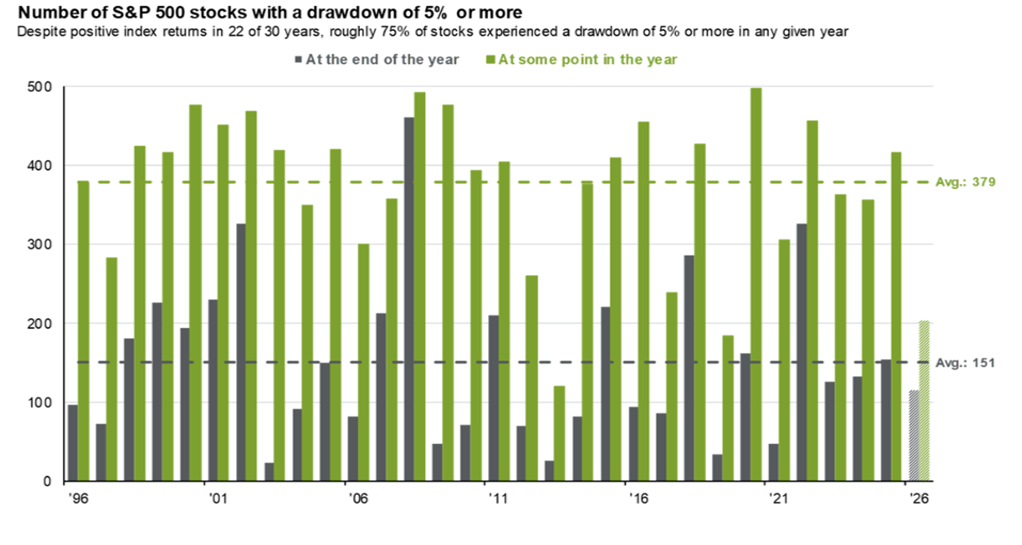
Tax Benefits: The primary reason that investors employ direct indexing is the ability to capture meaningful tax benefits. Even in strong market years, many individual stocks within an index decline in value. For example, although the S&P 500 gained nearly 18% in 2025, roughly 200 of its constituents experienced negative returns, and many others saw periods of temporary weakness. This dispersion creates tax‑loss harvesting opportunities that aren’t available when holding a single fund that represents the entire index. By owning the individual positions directly, investors significantly expand their ability to realize losses while still maintaining index‑like exposure. Concentration Reduction: Another benefit of adopting a direct indexing strategy is the ability to reduce concentration risk. We see many client portfolios with a handful of concentrated, highly appreciated equity positions. While these securities are good candidates for gifting strategies, a direct indexing approach can also aid in gradually reducing the concentration level over time. We often recommend funding direct indexing accounts with cash to generate losses and use those losses to responsibly trim appreciated positions. Those proceeds can then be contributed back into the strategy, promoting the ability to incur additional taxable losses in a virtuous cycle. Customization: Another motivation for investors to utilize direct indexing strategies is customization. The motives for customization vary. Some individuals use customization to add moral tilts around religious or ideological preferences. Others may use customization to express an investment thesis or to accommodate their personal circumstances. For example, someone who owns a large amount of real estate may elect to exclude the real estate sector from their direct indexing portfolio. An employee of a publicly traded company may exclude that company’s stock from their investment holdings to avoid additional concentration risk.
Leveraged Direct Indexing
In recent years, the strategy of leveraged direct indexing has become a hot topic amongst tax-focused wealth managers. The concept is straightforward: rather than holding a 100% long portfolio, you leverage your exposure by adding a proportion of short holdings, creating gross exposures greater than 100%. Some common strategies include 130/30 or 200/100 long/short weightings. The result is a net market exposure of 100%, but a greater gross exposure, enhancing the opportunity to harvest taxable losses. While that sounds beneficial in theory, due to greater opportunities to harvest losses, there are some considerations that should be thoroughly understood before adopting a leveraged strategy: Added Cost: While long-only direct indexing strategies are generally only modestly more expensive than a low-cost, passive index fund, adding short exposure changes the equation. Borrowing costs for shorting equities vary widely depending on the stock and general market conditions. However, leveraged strategies generally have substantially higher costs than their long-only counterparts. Elevated Tracking Error: In a long-only strategy, the manager’s job is straightforward: replicate the index with as little tracking error as possible and periodically harvest losses. When shorts are involved, the manager makes active bets to deviate from the benchmark in selecting which positions to short. We’ve reviewed several levered strategies and performance relative to the stated benchmark can vary wildly, often by several percentage points over the course of a year. In adding a short element to the strategy, you can accrue meaningful additional tax alpha, but it comes at a steep cost in tracking risk. Risk: During periods of elevated volatility, the costs of shorting stocks can increase. Furthermore, the potential loss on short-sales is unlimited. With a long equity position, the principal you invest represents the maximum loss. When short-sales are involved, the maximum loss can be multiples of the price at which the stock was sold short. This doesn’t necessarily mean that there’s no place in a portfolio for short-selling, it just requires an extra level of diligence around the manager’s strategy and guardrails.
Potential Drawbacks of Direct Indexing
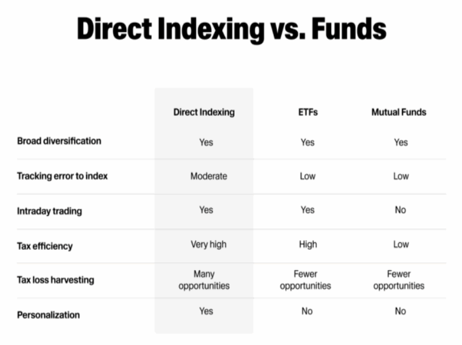
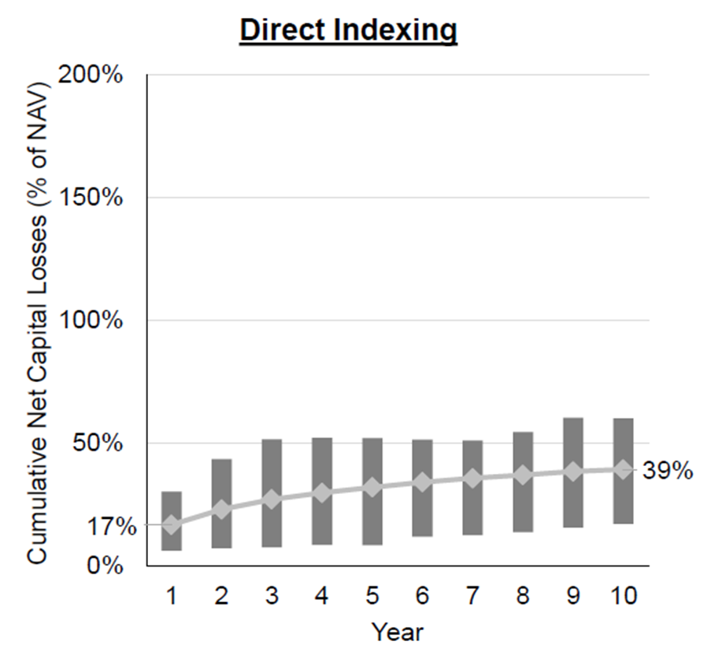
Higher Minimums & Fees: Direct indexing minimums have declined in recent years, so this is becoming less of a hurdle. However, some providers require $100,000 or more to open an account, depending on the index they’re seeking to replicate, amongst other factors. ETFs that represent an index can be purchased with essentially no minimum. While direct indexing costs have declined dramatically, they’re still higher than many passive index funds that replicate the same indices. Administrative Complexity: Owning hundreds of securities in an account rather than a handful of funds can add complexity at tax time. The tax reporting documents for these accounts can be lengthy due to the volume of transactions. This has become less of a concern as more custodians offer consolidated 1099s and improved tax software allows for documents to be imported rather than manually entered. However, it’s a factor to be aware of before adopting a direct indexing strategy. Diminishing Tax Efficiencies: While direct indexing strategies can provide compelling tax efficiencies in the early years of an account’s life, if funded with a reasonable proportion of cash, these benefits tend to diminish over time. As loss-lots are regularly being sold to harvest losses, the proportion of unrealized appreciation in the portfolio tends to increase over time, limiting the ability of the manager to generate large losses later in the account’s life. This can occur more quickly if equity markets appreciate rapidly. Later in the account’s life, dividends still allow for some degree of loss harvesting, but at a much slower pace than at the beginning. The use of a long/short direct indexing strategy extends the ability to generate losses but comes with its own risks and drawbacks, namely higher tracking error and cost.
Takeaways
Over the past few decades, ETFs have addressed one of the key drawbacks of mutual funds by giving investors greater control over the timing of taxable events. Direct indexing takes this concept a step further. While ETFs adopt a “do no harm” approach to tax management, direct indexing seeks to deliver passive, index‑like exposure while actively managing taxes to enhance after‑tax outcomes. Although it isn’t suited for every investor, direct indexing can offer compelling advantages. The most impactful use cases we’ve observed include gradually reducing concentrated positions, building a bank of realized losses to offset future gains, and customizing index exposure to fit individual circumstances. In recent years, the barriers to adopting direct indexing have continued to decline as minimums and costs have fallen. Innovation has also accelerated with the introduction of leveraged long/short strategies. While these approaches come with additional risks, they can provide meaningful benefits when applied thoughtfully. Direct indexing may not be the perfect solution for every portfolio, but in many cases, it can improve tax efficiency or help mitigate concentration risk—both of which are essential to optimizing after‑tax, risk‑adjusted returns.
Disclosure: This information was prepared by FSM Wealth Advisors, LLC d/b/a Journey Wealth Management, LLC, a federally registered investment adviser under the Investment Advisers Act of 1940. Registration as an investment adviser does not imply a certain level of skill or training. Neither the information presented nor any opinion expressed herein should be construed as personalized investment, financial planning, tax, or legal advice. For advice specific to your situation, please consult an appropriately qualified professional adviser(s). Certain information herein may have been obtained from various third-party sources; Journey does not guarantee the accuracy or completeness of such information. Investing involves the risk of loss and investors should be prepared to bear potential losses. Past performance is not indicative of future results.

Alternative Investments Overview
Alternative investments can play a valuable role in a portfolio—but only when used with a clear purpose. This overview explores how alternatives may enhance returns, improve diversification, and support tax efficiency, while highlighting the risks, structures, and planning considerations investors should understand.
Direct Indexing Overview
“Direct indexing offers investors a more customizable and tax-aware way to gain broad market exposure. By owning individual securities rather than a single fund, investors may create more opportunities for tax-loss harvesting, reduce concentrated positions over time, and tailor portfolios to their specific circumstances.

Quarterly Market Commentary
Equity markets in 2026 resemble a revolving door, with leadership regimes swinging wildly from small caps to value and then to growth equities. The rapid rotations we’ve witnessed over the past six months demonstrate the futility of attempting to time equity markets.