



Insights Blog
Four Pillar Friday
March 13th, 2026 // Adam Bruderly
Physical Wellness
You already know sleep matters. What you might not know is how much.
A study published in JAMA Network Open looked at people actively seeking mental health care and tracked the relationship between sleep, physical activity, and daily mood. What they found wasn’t complicated, but it was pretty clear. Both sleep quality and physical activity were independently associated with better mood outcomes. Not one or the other. Both…together.
Here’s what I find interesting about that. Even though this relationship is starting to shift and becoming increasingly important for people. Most treat sleep like a variable, something that gets whatever time is left over after everything else is done. And most people treat physical activity the same way. It’s the first thing to go when life gets full.
But this study isn’t talking about elite performance or optimization. It’s talking about people who are already struggling. And even in that population, the two fundamental basics: move your body, and protecting your sleep were making a measurable difference.
The foundation isn’t complicated. It’s just inconvenient to prioritize. And it almost seems too easy to have that much impact.
If there’s one question worth asking yourself this week: which one are you short-changing right now, sleep or movement? And what would it actually take to protect it?
Mental Wellness
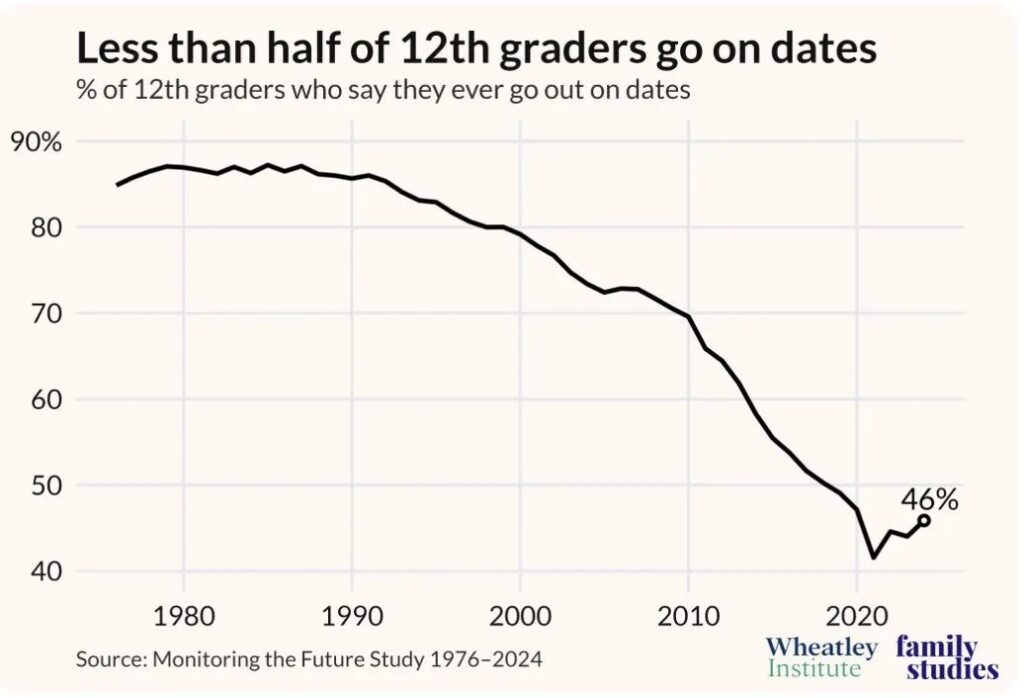
Look at this chart.
In 1976, 85% of 12th graders said they went on dates. Today that number is 46%.
Everyone talks about lonely teenagers. I keep thinking about what comes next.
The kids who stopped connecting in 2012 are adults now. They’re in the workforce. Leading teams. Starting families. And that same pattern…loneliness, difficulty with real relationships, discomfort in unscripted conversation…is showing up everywhere.
Accomplished. High-performing. And somewhere underneath it, disconnected in a way they can’t quite explain.
This data doesn’t just tell you where we are. It tells you what’s coming down the funnel.
The loneliness epidemic isn’t coming. It’s compounding. And the generation behind them has even less practice at the thing that matters most. Like showing up, being present, communicating and connecting without a screen between you.
I see it every week in the work I do. The skill of real connection doesn’t just happen. It has to be practiced. And for a lot of people, that practice stopped a long time ago.
When was the last time you had a real conversation? Either unplanned, unhurried, and with no agenda with someone who matters to you?
Financial Wellness
Two people. Same income. One feels financially secure. The other is anxious about money every single day.
Research published in the Journal of Economic Psychology examined exactly this gap. The distance between what you have and how you feel about what you have. What they found was that the relationship between objective wealth and subjective wealth isn’t automatic. It’s filtered through two things: your ability to feel in control of your finances, and the anxiety you carry around money.
People with higher perceived financial control felt significantly better about their financial situation than their actual numbers alone would predict. The inverse was also true. Money anxiety didn’t just make people feel worse. It actively distorted how they evaluated what they had.
How you feel about your money isn’t just a reflection of how much you have. It’s shaped by whether you feel like you’re in control of it and by how much mental and emotional weight you’re carrying around it.
I’ve seen this in practice more times than I can count. Someone with significant assets who can’t sleep at night. Someone with far less who feels genuinely at peace. The number definitely isn’t the whole story.
The real work in financial wellness isn’t just growing the balance sheet. It’s building a relationship with money that doesn’t cost you more than the money is worth.
Spiritual Wellness
Harvard Medical School recently convened one of the more interesting conferences I’ve come across. They brought together psychiatrists, psychologists, neuroscientists, and chaplains to examine what the research actually says about spirituality and mental health.
The conclusion wasn’t a soft connection. Researchers from Harvard, Stanford, and Duke found strong evidence linking spiritual practice and community, in whatever form that takes, to lower rates of depression, reduced suicide risk, better recovery from substance use, and meaningfully better overall health outcomes.
And what is remarkable is what lies underneath it. What seems to matter most across all forms is a sense of shared purpose, connection, and meaning within a community. Religious communities tend to do that consistently. But it’s the elements, not the institution, that drive the outcomes.
Now more than ever, people are searching for exactly that. A sense of meaning that holds across time. A community they actually belong to. A framework that makes the hard moments navigable.
That’s not entirely a spiritual problem. It’s a human one. And the research keeps pointing in the same direction.
The question isn’t what form it has to take. It’s whether what you have brings you a deep sense of community, practice, and a way of making sense of things that goes beyond the day-to-day noise.
And In The End
From all of us at The 9:03 Collective: thanks for reading. Keep showing up. Stay curious. And never forget that the clock is running, so make it count.
If you’ve been enjoying Four Pillar Friday, the best way to support is simple: share it with a friend, forward it to someone who might need it, or subscribe if you haven’t already. The more people we reach, the more conversations we can spark about living with intention.
Until next week….
The Journey Team & The 9:03

Quarterly Market Commentary
Equity markets in 2026 resemble a revolving door, with leadership regimes swinging wildly from small caps to value and then to growth equities. The rapid rotations we’ve witnessed over the past six months demonstrate the futility of attempting to time equity markets.

Four Pillar Friday
Stories, research, and reflections on how we spend our most important currency: TIME

Four Pillar Friday
Stories, research, and reflections on how we spend our most important currency: TIME