



Insights Blog
Conflict & Markets: How do recent geopolitical events impact your portfolio?
March 11th, 2026 // Jack LaLiberte
Geopolitical risk has bubbled to the surface in recent weeks as the US & Israel have taken military action against Iran. Iran, not unexpectedly, retaliated in-kind. The somewhat surprising aspect of the retaliation has been Iran’s acts of aggression against the Gulf states, previously seen as tranquil havens in a region often wracked by instability.
Equities have experienced some modest volatility as market participants digest the potential impact of the recent escalation. Fortunately for the globally allocated investor, the Middle East makes up less than 1% of the global equity market index, as measured by the MSCI ACWI. The reaction in fixed income has been more dramatic, with yields increasing. This is likely due to investor concerns around the government’s need to issue more debt to finance the conflict, on top of existing fiscal concerns. Unlike last year’s Liberation Day tariffs, geopolitical conflicts are rather frequent and largely inconsequential for long-term returns. The factor that may prove disruptive to the global economy is the cost and flow of energy. About 20% of the world’s oil supply travels through the Strait of Hormuz, over which Iran can exercise a large measure of control.
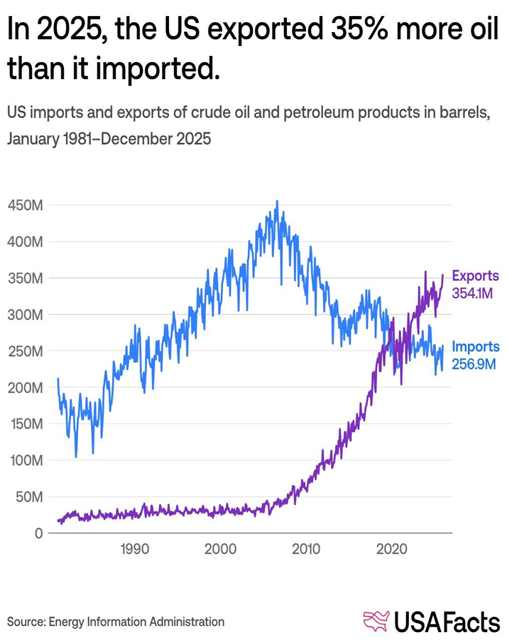
The US is much more insulated from oil price shocks than in past decades. Since 2020, the US has been a net oil exporter, with the gap between imports and exports expanding to about 100 million barrels in 2025. US natural gas production is also at record levels, more than doubling over the past 25 years, insulating domestic energy prices to a degree. However, energy markets are global in nature. If supply constricts elsewhere, the impacts will likely be felt domestically. Domestic inflation has been improving slowly but steadily, largely due to sluggish growth in housing prices. Falling energy prices over the past three years have also aided in curtailing inflation. If energy prices experience a sustained uptrend, additional inflationary pressure could postpone expected Fed rate cuts. As is generally the case, core fixed income assets are likely a much better hedge against global volatility than outsized cash holdings, as a true growth shock may promote accommodative Fed policy, amplifying reinvestment risk and rewarding quality fixed income assets.
Equity Markets & Geopolitical Events
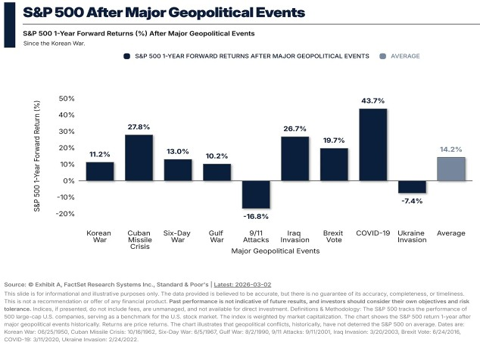
While it’s easy to get caught up in the day-to-day headlines, the trajectory of global growth is unlikely to shift due to the ongoing conflict. Historical data indicates that most armed conflict has little long-term impact on global markets. The chart below illustrates one-year returns after major geopolitical shocks, noting that in nearly every case the S&P 500 had a positive return over the following year, with an average one-year return of 14.2%. The recent exception was the Russian invasion of Ukraine in 2022. In that case, it’s far more likely that poor equity performance was due to the Fed’s dramatic interest rate hikes rather than fallout over the European conflict.
Conflict is Constant, Markets are Resilient
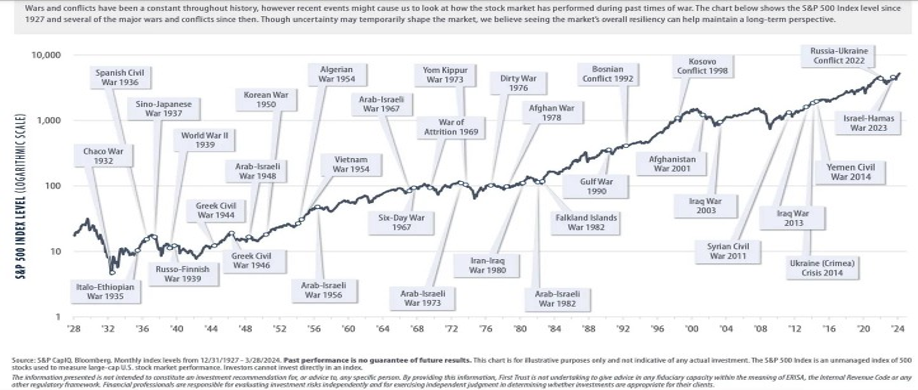
Unfortunately, there’s nearly always a war occurring somewhere in the world at any given moment. While these represent their own set of personal tragedies for those involved, the machinations of the global economic engine are largely unaffected. In 2026 alone, there are several major conflicts taking place: an ongoing war in Ukraine, the recent conflict with Iran, armed border clashes between Afghanistan and Pakistan, as well as the tragic civil war in Sudan. Yet, despite these conflicts, global commerce continues to flourish.
Takeaways
At Journey Wealth, we understand that the news is often concerning. The humanitarian and political implications of these conflicts are likely to be expansive. However, markets are resilient. Global equity markets serve as a conduit to transmit your hard-earned capital to companies that are innovating around the world, whether that be semiconductor manufacturers in Taiwan, defense contractors in Europe or auto-makers in Japan. Those companies are going to continue to innovate and develop products that allow us to maintain and enhance the remarkable standard of living we enjoy today, regardless of short-term volatility. When markets are volatile, we believe it’s critical to ensure that:
- Your investments are globally diversified. No one knows where the best opportunities will come from over the next decade. Additionally, global diversification meaningfully smooths out the long-term investment experience when regionally specific challenges occur. Last year, for example, a US- heavy investor dramatically underperformed a global portfolio due to the impact of tariffs.
- You have the cash reserves you need, but not more. If you’re taking distributions from your portfolio for living expenses, you should ensure your cash reserves are adequate. However, holding excess cash due to general uncertainty isn’t an optimal long-term strategy, particularly if inflation re-accelerates.
- Remain focused on your personal plan and goals. We find that periods of market volatility serve as an opportune time to review your portfolio and ensure that your asset allocation aligns with your goals.
As always, please don’t hesitate to reach out to your advisor to discuss your financial plan and how your portfolio is structured to achieve your goals. While concerning headlines aren’t likely to slow down, there are a myriad of quiet growth catalysts at work, compounding capital for those with the patience and resilience to allow markets to do what they do best.
Disclosure: This information was prepared by FSM Wealth Advisors, LLC d/b/a Journey Wealth Management, LLC, a federally registered investment adviser under the Investment Advisers Act of 1940. Registration as an investment adviser does not imply a certain level of skill or training. Neither the information presented nor any opinion expressed herein should be construed as personalized investment, financial planning, tax, or legal advice. For advice specific to your situation, please consult an appropriately qualified professional adviser(s). Certain information herein may have been obtained from various third-party sources; Journey does not guarantee the accuracy or completeness of such information. Investing involves the risk of loss and investors should be prepared to bear potential losses. Past performance is not indicative of future results.

Quarterly Market Commentary
Equity markets in 2026 resemble a revolving door, with leadership regimes swinging wildly from small caps to value and then to growth equities. The rapid rotations we’ve witnessed over the past six months demonstrate the futility of attempting to time equity markets.

Four Pillar Friday
Stories, research, and reflections on how we spend our most important currency: TIME

Four Pillar Friday
Stories, research, and reflections on how we spend our most important currency: TIME